
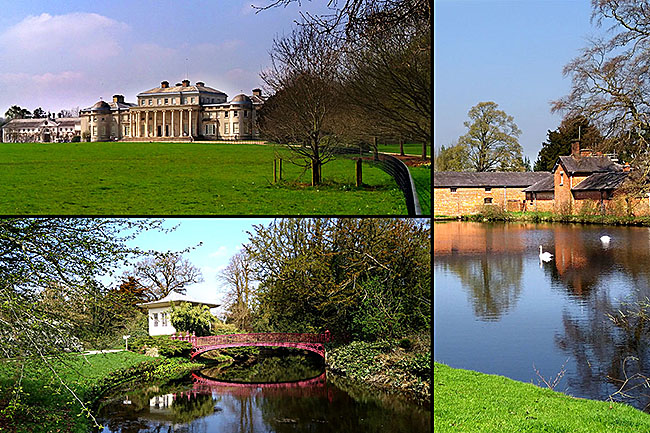
The first thing that you notice as you follow the long driveway through the Shugborough estate, unless you are fortunate to spot a deer, is the Triumphal Arch, built around 1760 and based on the Arch of Hadrian in Athens. This is the first of twelve Follies to be seen in a complete tour of the grounds and the extensive, surrounding park.
The next thing that may strike you is how friendly and welcoming the staff are. There is sometimes a stiffness and arrogance about those that man the tills at National Trust gateways, but not here. From the gardeners who seem ever keen to respond to an enquiry with a friendly chat to the cheery servers at the café counter, they all exude an eagerness to exchange pleasantries.
Just beyond the entrance gate, the walled garden offers little of interest beyond its ancient brickwork. Next comes the farm, which, depending on season, may be incubating new borns or protecting expectant mothers in its old stable block and offers early refreshment for those who have journeyed far at its café and courtyard tables.
But the visitor may be disappointed by these underwhelming early sights and needs to hurry down the main path, pausing only at the Tower of the Winds, down the drive to main house, where the imposing ten pillared façade impresses from afar. Up the steps and within, sitting amongst the usual ancient artefacts and mandatory paintings is a well laid out, intriguing and highly informative, if a tad repetitive, exhibition about the two brothers who established Shugborough and how it came to be paid for by plundered treasure.
The formal garden behind the house is a well kept but modest example of its kind, which could do with a few more benches if to be enjoyed fully. It leads down to the riverside Ruin, another folly, built as an artificial ruin of old stone from a former manor house, and now a ruin of the original Ruin, decimated by a tumultuous flood in 1795.
The river here is a rerouting of the River Sow, which has two arms between which is an island, accommodating the Arboretum and accessed at each end by delightful and photogenic bridges, one of which stands adjacent to the Chinese House. From the main house and through the Arboretum is a most pleasant stroll, especially if ended with a diversion to the Essex Bridge at the far end of the estate.
Here the two arms of the Sow converge with the River Trent to pass under the longest remaining packhorse bridge in England. Grade 1 listed, only 14 of the original 40 spans remain of the magnificent structure commissioned by the Earl of Essex in the sixteenth century to provide a route from his nearly estate to the hunting on Cannock Chase. Here is an opportunity to marvel at both the fortitude of the ancient structure and the lack of girth of what must be one of the narrowest bridges in the nation.
Whilst the farm and gardens may be fairly ordinary and the parkland may not reach the sublime standards of those crafted by Capability Brown, the Mansion and its exhibition, the riverside ramble, the curiosity arousing follies and the magnificent bridges make Shugborough a worthy half day visit for a sunny day out.
And a tip, get to the Mansion Tea Room before noon if you fancy a sausage, bacon and egg ‘breakfast’ sandwich, it will be worth it and there will be room to sit, as the place fills up quickly after twelve as the breakfast items come off and the jacket potato lunch roll out.