
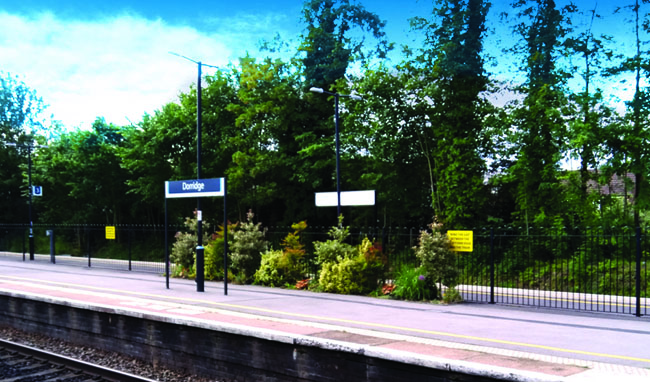
The Great Western Railway (GWR) did not pass through Knowle, but had a Knowle Station, included to serve the commuters who worked in Birmingham but lived in the growing suburb village. As a new hamlet of Dorridge grew around the station it was renamed ‘Knowle and Dorridge Station’ before being named as we know it today – ‘Dorridge Station’.
In 1852 the GWR opened the service on its line from London to Birmingham, with its station at ‘Knowle’. The line terminated at what was then known as Livery Street Station in Birmingham. It had been planned that it would terminate at Curzon Street as is the Euston line. Earthworks and a viaduct from Bordesley towards Curzon Street, the so called Adderley Street spur, were built but they were never used. Congestion at Curzon Street and disputes between the GWR and the LNWR resulted in the rerouting to the new station. This station was renamed Snow Hill Station in 1858, after the line had been extended to Wolverhampton in 1854.
Initial journey times for the 129.5 miles from Birmingham to Paddington were 3 hours and 16 mins. There were first, second and third class carriages, although third class was in little more than goods wagons with wooden bench seats and second class little better, with nominal padding. There were no toilets, no refreshments and, until 1893 and the introduction of corridors, no movement between coaches.
The service competed with the LNWR line from Euston to New Street and in 1859 the GWR run from Snow Hill to Paddington through ‘Knowle’ was the faster of the two by 10 minutes at 2hrs and 50 mins. By 1880 a GWR express service to Birkenhead was timetabled to stop at Snow Hill after 2 hrs and 42 mins.
The line was built to the GWR Broad Gauge standard with 7ft wide track. This differed from the Narrow Gauge 4ft 8 1/2in track used by all other railways. As a result there all sorts of problems in track change-overs at junctions with points and rolling stock. An Act of Parliament stipulated that all new track would be Narrow Gauge and GWR faced the necessity for change. In 1869 a third rail was added between the original two allowing trains of both gauges to run over the track. In 1891 the wider gauge was finally eliminated.
Meanwhile, in 1874 an open cutting from Snow Hill Station to Temple Row had been arched and upon these arches was built the Great Western Arcade, a historic feature of Birmingham still in use today. But the tunnel and Snow Hill beyond could not cope with demand, so the Moor Street terminus was built before the tunnel between 1909 and 1914 to remove the pressure from Snow Hill, and particularly to take local North Warwickshire lines traffic. In 1910, second class was removed from the trains leaving just first and third.
In 1927 the ‘King’ class locomotives were introduced to the GWR and were generally regarded as the finest locomotives in the world for some time to come. They were to become workhorses of the GWR lines. In 1959 the GWR was absorbed into the Western Region of British Railways on nationalisation.
BR set about the electrification of the Euston to New Street line in 1958 and the old GWR line carried additional trains over the next few years to compensate, record numbers of trains and passengers being carried on the route. A new Birmingham Pullman service was introduced stopping only at High Wycombe. Then in 1962 came the introduction to the line of diesel locomotives and the withdrawal of steam. But it was the electrification that sounded the death knell for the line and on 6th March 1967 the final express to Snow Hill left Paddington. Snow Hill declined further and closed altogether on 4th March 1972. Local trains from Dorridge, Leamington and Stratford meanwhile were terminating at Moor Street.
Although a much diminished express service continued from Paddington through to New Street, this was a bridesmaid service slowed down by the ensuing decay of the infrastructure, reductions to single line working and the use of different routings, via Reading and Didcot to Banbury and via Coventry instead of Dorridge and Solihull. It served stations in between but did not compete with the Euston service for London to Birmingham passengers.
But after a mere 15 years, Centro developed a new strategic vision and a new Snow Hill Station was built and opened October 5th, 1987. At the same time, new Moor Street platforms were built and the old terminus next door to them was closed and began to decay. Rail technology changed again, and comfortable, fast and efficient multiple unit trains, now using London Marylebone, are once again competing successfully with the alternative route from New Street to Euston (the latter being ‘a bit faster but twice the price’).
The clock was turned back once again with the rebuilding and reopening of the old Moor Street terminus, to operate two new platforms alongside the through platforms and 2011 saw the reintroduction of a ‘mainline’ service from Birmingham to London along the line. Dorridge Station users now take for granted seeing a a frequent service both stopping at and passing its platforms, the years when this was not the case are largely forgotten.
There has been talk of restoring the route from Dorridge to Birmingham to 4 track, as it was in its heyday, so that even more throughput can be achieved on the line, and there are firmer plans to connect the freight line from Kings Heath to Duddeston, which crosses the Snow Hill line at Bordesley, so that commuter trains from those directions could terminate at alternatives to New Street.
Meanwhile, that period, not long since, when the line beyond Leamington saw no passengers is well consigned to history.